Monday, April 27, 2015

Sea hares!

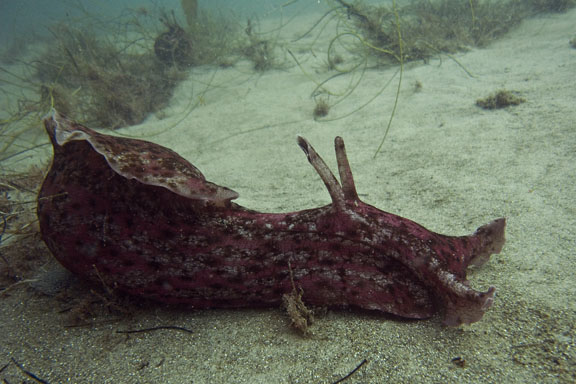
Wow! We saw SO many sea hares on our trip to the Coal Oil Pt tidepools on April 16th.  The California sea hare (Aplysia californica) is a gastropod mollusk (think common garden snail) without an external shell.  This species is found along the California coast.


Some interesting notes about its physical characteristics:

Alpysia has two pairs of tentacles on top of its head: one pair up front near the mouth that help in movement and another behind the eyes used in olfaction. It is the large anterior tentacles, which resemble the ears of a hare, that are responsible for the common name - sea hare.

The color of sea hares, which can range from purple-reddish-brown to greenish-brown, depends on the color of algae they eat.  This year we saw many sea hares that were definitely more on the green end of that scale, which makes me wonder if there is different availability of algae from previous years.

These guys can get big - CA "brown" sea hares (Aplysia californica) can get to be up to 40 cm (16 in) long.  However its close relative - the California black sea hare (Aplysia vaccaria) gets even bigger, up to 75 cm (29 in), making IT the largest gastropod in the world.

And about its reproduction....
we mentioned in the field that sea hares are hermaphrodites - simultaneously both male and female.  For a peak at their mating "strategies" check out this National Geographic video entitled "World's Weirdest - Underwater Love Chain" !!


 and links to previous entries about rocky intertidal trips are here.

More on the CA sea lions

The Santa Barbara Independent just ran this story ("Rescuing Sea Lion Pups") about this year's huge influx of ill or malnourished sea lions on our Santa Barbara beaches. It also describes some of the key local players - including Peter Howorth - who are working hard to rescue and rehabilitate these and other marine mammals found on local shores.

Peter Howorth used to trap sea lions for sale. Now he’s trying to rescue them. After having caught “tens of thousands,” he makes it look easy. Photo by Paul Wellman in the SB Independent 4/16/15

Monday, April 20, 2015

California sea lions

We visited the Carpinteria Bluffs on our first "away" field trip and enjoyed seeing the harbor seals at the rookery beneath the bluffs.  According to the docents there have been about 100 born this year which is slightly below last year's count.  I don't recall ever seeing this on previous trips, but this time we observed a couple seal lion pups on the beach as well.  The difference between these two species of pinnipeds was readily apparent.  Here's a brief reminder:
             seals: no external ear flaps, short front and rear flippers, mostly silent
             sea lions: external ear flaps, longer and opposable flippers, bark!

                                from: http://oceanservice.noaa.gov/facts/seal-sealion.html

While the harbor seals are successfully rearing and weaning their pups, the California sea lions have been having a rough year.  There has been high mortality of sea lion pups, possibly because the warmer waters this year have meant few fish nearshore for new moms, who must go farther and leave their young pups alone and hungry.  Read this article from the LA Times about the strandings (reports are that over 2,000 pups have been stranded this year) and this one from the Smithsonian, which asks whether we should focus on rehab or on the underlying causes of the problem.

Check out previous posts about the Carpinteria Bluffs here.

Monday, April 6, 2015

Welcome 2015 Walking Biology!

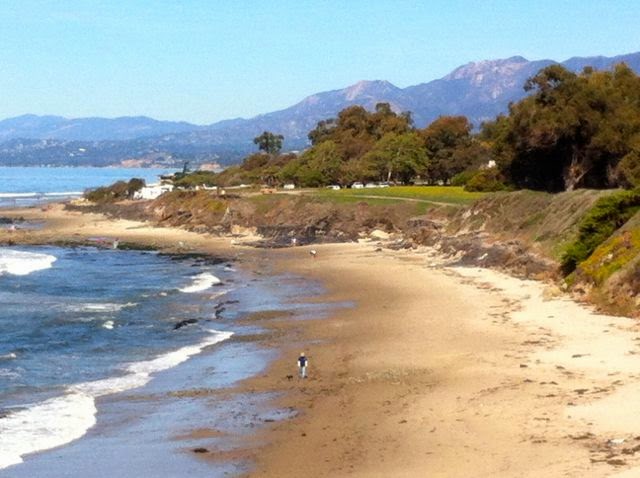
... and welcome spring!  We started this quarter with a stroll along the campus lagoon.  Check out this site with more information on the lagoon's formation and current management from the Cheadle Center for Biodiversity and Ecological Restoration (CCBER).


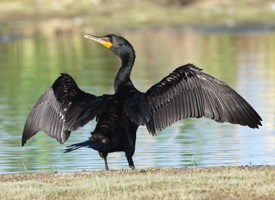
One of the species of birds that we observed was the Double-crested cormorant.  They commonly are observed roosting on the eucalyptus trees near the edge of the lagoon, often with their wings spread out to dry.  As described in the Cornell Lab of Ornithology website (a superb source of information!), the cormorants "have less preen oil than other birds, so their feathers can get soaked rather than shedding water like a duck’s. Though this seems like a problem for a bird that spends its life in water, wet feathers probably make it easier for cormorants to hunt underwater with agility and speed."  Cool!
Visit the Cornell Lab's website here: http://www.allaboutbirds.org

Monday, June 2, 2014

Live Oak - Santa Ynez

Gianna, Kai, and I drove up the road to Live Oak after class this last week. 
It was absolutely beautiful, so I wanted to share a few photos with the group!

Enjoy.
:)


Thanks again for the popsicles, Claudia! 


Monday, May 19, 2014

Campus flora 2014

We saw lots of interesting species on our campus walk.  One of these was the Bunya Bunya, Araucaria bidwillii, native to Queensland (NE), Australia.  Other common names include bunya pine (though it is not a "pine"), and false monkey puzzle tree (it belongs to the same genus and resembles the monkey puzzle tree.)  


A striking feature of this tree are the stems with very sharp, pointed, tough leaves. Could this morphology have helped protect from herbivory in the Mesozoic (age of reptiles) when this tree was widespread? 


We also noticed many insects on the bark of the tree.  As a couple of our insect-knowledgeable students pointed out, these were likely mealybug eaters, though they looked like mealybugs themselves (the insects, not the students...)  Read more about these and the Araucaria genus at waynesworld.palomar.edu. (source of the photo below).


We didn't see any but we talked about the cones of this species  The cones are huge - 20–35 cm in diameter (the size of footballs)!   They contain large, edible seeds.  Because of these large cones, it can be a hazard to be underneath when the cones drop.  Check out this article from the ABC (Australian Broadcasting Corp.) "Living under Bunya Pines is not for the faint hearted".


Wednesday, April 30, 2014

What a day at Coal Oil Point! Whales and octopus and plovers, oh my!

from marinebio.net by Genny Anderson
Sparklin' day at Coal Oil Point last Thursday - starting with the two gray whales breaching just beyond the kelp forests off the point!   At this point the gray whales are migrating north, back to the Bering Sea where they spend the summer.  Check out SBCC prof Genny Anderson's site for information about the gray whales and their journey past our coast.


Thanks to Zeke for finding our first octopus!  Again, some great info about this and other "treasures" we spotted, like the sea hare, I recommend Genny's site.  This is the page to read about low intertidal organisms.

We saw some of the sandy beach denizens.... those beach hoppers under the drying kelp wrack are so crucial to maintaining the bird diversity we saw.  Here is a nice page by UCSB researcher, Jenny Dugan, about the role of beach wrack and comparisons of "groomed" vs ungroomed beaches.

And finally, if you'd like to read about the snowy plover program (and perhaps even volunteer to be a docent)  click here!

from http://coaloilpoint.ucnrs.org/SnowyPloverProgram.html


Wednesday, April 23, 2014

Chaparral at "Lizard's Mouth"

Beautiful afternoon at "Lizard's Mouth" in the Santa Ynez Mountains!  We came to this site to see chaparral - the natural community that dominates the slopes facing Santa Barbara.  We saw great examples of some of the plant species' adaptations to our Mediterranean climate, including manzanita, chamise, bush poppy, and chaparral yucca with their tough water-conserving leaves.  Also in bloom was snowdrop bush, which manages to survive much of the drought (perhaps due to deep tap roots) but drops it leaves (deciduous) by the fall, and only grows new ones when the rainy season begins.
Bush poppy
Chamise


California scrub oak

Snowdrop bush


Manzanita
Chaparral yucca


But really... we also came to enjoy the rock-hopping and great views.  Even though it was a bit overcast, so we couldn't get a great ocean view, it was still pretty spectacular.


Saturday, April 12, 2014

Carpinteria Bluffs Reserve


Nice walk to Carpinteria Bluff Reserve this week!  There have been fewer harbor seal pups born this year according to the docents at the overlook, who said ~75 have been recorded as compared to the past few years when ~100 were born.  There were several at the site when we visited, though they are now getting fairly big!

Some previous posts from this site are here.
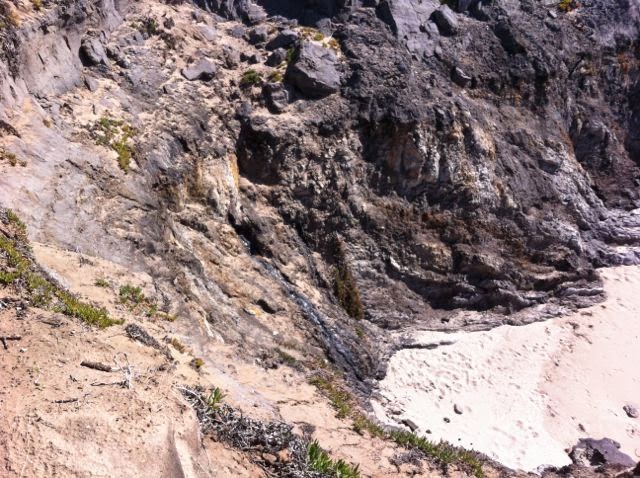
This year we continued our walk along the bluffs beyond the pier, heading west to Tar Pits Park.  There we could see one of the places along the beach where the asphaltum bubbles out forming a mound from the bluff onto the sand.   Looking west we could see a bit trickling out from the rocks down toward the beach, too.

Tar pits park - looking west
Tar "sliding" down the rocks
You may want to read more about Carpinteria's Tar Pits, which are pretty cool!  In our book (Lentz 2013) see pp 57-60.  There is also information about the site on these pages:
from carpinteria.com,   caopenspace.org,  and parks.ca.gov 

From the latter: 
“The Carpinteria Tar Pits once bubbled up near the state beach. Spanish explorers noted that the Chumash caulked their canoes and sealed their cookware with the asphaltum. Around 1915, crews mined the tar, which was used to pave the coast highway in Santa Barbara County. In order to dig the tar, workmen had to heat their shovels in a furnace; the smoking tar would slice like butter with the hot blade. Long ago, the tar pits trapped mastodons, saber-toothed tigers and other prehistoric animals.”


Thursday, April 10, 2014

New Guide to the Natural History of the Santa Barbara Region

We’re using a new book for Walking Biology this year!  Published just recently is the natural history guide just for us – all about Santa Barbara and its surrounding area.  It is written by long-time resident and natural historian, Joan Lentz, who has also written field guides on Southern California birds (and led many local birdwatching classes).  It is available from Heyday Books (the publisher) and other retailers.


Read more about author Joan Lentz on her website: http://joaneastonlentz.com/

And if you'd like to read reviews of this book from our local press, here is an article from the SB Independent, and one from noozhawk.com

Joan Easton Lentz. 2013. A Naturalist’s Guide to the Santa Barbara Region.  Heyday Books, Berkeley, CA


Wednesday, April 9, 2014

Field Notes on Science and Nature


You all might enjoy this book (published in 2011 by Harvard Univ Press), which compiles accounts by notable natural historians writing about their experiences in recording their observations in the field.  This is a celebration of the field notebook, and includes examples of some amazing journals and illustrations.  The book is edited by Michael Canfield, who writes, “The tradition of field notes that grew into its own genre over the past three centuries is still relevant to anyone who studies nature... Although the diversification of field pursuits and the complexity of their studies have expanded the scope and methods for field documentation, the basic role and importance of field notes are unchanged."


Several nice reviews are here: Betsy Mason (Wired.com) and John Anderson (Natural HistoryNetwork).

Saturday, April 5, 2014

Start of Walking Biology 2014!

Welcome to our blog for spring 2014!  Our first walk was a short one - to campus lagoon - just to get a taste of what's to come.  Feel free to post photos or writings about our walks here.  Each week I'll also add some information about the places we've visited so you can learn more about them on your own.


For example...  in case you are interested here are some good resources with information about UCSB's campus lagoon, from CCBER (The Cheadle Center for Biodiversity and Ecological Restoration):

http://ccber.ucsb.edu/sites/default/files/lagoon_overview.pdf
http://ccber.ucsb.edu/ecosystem/habitats-wetland/lagoon
http://ccber.ucsb.edu/ecosystem/management-areas/campus-lagoon
 

Monday, June 10, 2013

Creativity inspired by nature...

I've created a series of drawings that aim to teach about some of the ecosystems that we visited during the quarter. As a biology major and having a focus on marine biology, I find that I tend to naturally become biased towards marine ecosystems when it comes to being creative with biology.

These are the first three drawings in my series. I've got one more in the works, but as the quarter is ending I thought I should post what I have now and hopefully will maintain my motivation to keep going and post more in the future.
I hope you enjoy them because I certainly had fun looking up facts and making these.

Thank you Claudia for a wonderful last quarter with CCS and at UCSB.

-Thea


Friday, May 24, 2013

Pickleweeds and parasites

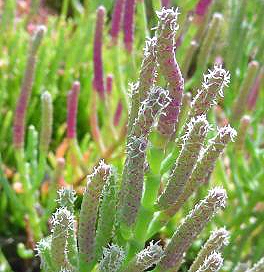
The dominant plant in the salt marsh / slough habitats we observed was Salicornia virginica or "pickleweed" - so named because of its pickle-like appearance and salty taste.  Another common name is "glasswort".  This name is related to its use (centuries ago) --> - pickle weed was burned to produce a soda ash used in glass making.  Some other interesting notes about this plant:
• Ashes of pickle weed were utilized in the production of soap by Native Americans
• Tips are harvested and used in salads, steamed to serve as a vegetable, or pickled


And according to Wikipedia:
“The plant is one of the salicornia species being tested as biofuel crop as it is composed of 32% oil and being a halophyte can be irrigated with salt water”, which is much cheaper than freshwater. 

More info about pickleweed is given here on the Aquarium of the Pacific site.

 The other cool thing we observed about pickleweed was its association with the parasitic plant Saltmarsh dodder or "Witch's Hair", Cuscuta salina

 It's not silly-string, after all!

Tuesday, May 21, 2013

Flora right in front of CCS!

We had a nice walk around campus to view a very small portion of the flora.  I overlooked a few noteworthy plants right in front of our very own Old Little Theater.  We did talk about the Canary Islands Dragon's Blood (Dracaena draco), the Island Ironwoods (Lyonothamnus floribundus), and the sages (Salvia sp).  I took some photos and wanted to share some info about a few others...


The tree in the SW corner in front of the OLT is a Shamel (or Mexican) Ash, Fraxinus uhdei, in the olive family (Oleaceae).  Native to western and southern Mexico, and introduced to the U.S. as an ornamental tree.  Fruits are yellow-green winged seeds.  The sap from the stems or leaves may cause a skin rash!
Shamel ash, Fraxinus uhdei
Winged seeds of the Shamel Ash
 

One of the shrubs right in front of the OLT is the California flannelbush (or Fremontia), Fremontodendron californicum, which is in the mallow family (Malvaceae).  Native to California and western N. America.  This shrub is found on slopes in chaparral and dry woodland.  The leaves are fuzzy, or “flannel”-like.  Be careful - the hairs on the leaves are easily brushed off and can irritate your skin.  But aren’t those bright yellow blossoms beautiful!


Fremontia, or Flannel-bush, Fremontodendron californicum


Adorning the west-side of our CCS building, is the Matilija Poppy, Romneya coulteri, in the poppy family (Papaveraceae).  Native to southern California and Baja California.  This perennial plant grows in chaparral and coastal sage scrub habitats, often in dry washes and canyons, generally away from the coast. The showy white flowers (that look like fried eggs!) are the largest of any plant native to California.

Matilija Poppy, Romneya coulteri


Thursday, May 16, 2013

How to post to the blog

This information will be archived as one of the links on the right hand side.

HOW TO SIGN UP TO POST TO THE BLOG
You all received an invitation to join the blog. If you need me to send a new invite just let me know.
The invite comes as an e-mail from google with the heading: 'You have been invited to contribute to CCS Walking Biology Blog'. This will contain a link.
If you click on the link you will have two choices:
If you already have a Google account just log in with your username and password and follow the instructions.
If you don't have a Google account then click the link to sign up for an account. This requires very little in the way of information - just a valid e-mail, the password you want, and the name you want to use. I think you will then get sent an e-mail with a link to click on to validate your account.
If you haven't received that e-mail then check your spam folder since it is an automated e-mail it may have been filtered out as spam.

HOW TO POST
Adding posts is really easy. Starting from scratch you would go to:
http://www.blogger.com
and sign in at the top with your Google username and password.

You should then see the dashboard with the CCS Walking Biology Blog. Click on 'New Post' and a simple word processor type screen will come up. Adding a text only post is as simple as typing it and hitting 'Publish Post'. You will probably also want to add links though (the whole point of the blog really) and adding links is very easy. Just highlight the text you want linked and click the word 'link' on the toolbar at the top of
the entry form. Just cut and paste the link in directly from your browser, including the http://.

Further buttons at  the top allow you to format the text, add pictures, spell check and, usefully, remove all the formatting from any section. You can preview posts before publishing them if you wish. Oh and the spellcheck is automatic and very easy to use but comes up with some very strange and amusing corrections for words it doesn't know. It is a good idea to test any links after you have posted to make sure they work (and work as you expect).

Let me know if you have any questions. Rather than give a big long tutorial on how to use the blog publisher  I suggest you just play with it and then ask questions. It is very easy to delete posts, and preview them before you publish, so you can practice without messing anything up.

(thanks to John Latto for writing up these instructions for the CCS Bio Blog!!)