Showing posts with label Carpinteria Bluffs. Show all posts

Monday, April 20, 2015

California sea lions

We visited the Carpinteria Bluffs on our first "away" field trip and enjoyed seeing the harbor seals at the rookery beneath the bluffs.  According to the docents there have been about 100 born this year which is slightly below last year's count.  I don't recall ever seeing this on previous trips, but this time we observed a couple seal lion pups on the beach as well.  The difference between these two species of pinnipeds was readily apparent.  Here's a brief reminder:
             seals: no external ear flaps, short front and rear flippers, mostly silent
             sea lions: external ear flaps, longer and opposable flippers, bark!

                                from: http://oceanservice.noaa.gov/facts/seal-sealion.html

While the harbor seals are successfully rearing and weaning their pups, the California sea lions have been having a rough year.  There has been high mortality of sea lion pups, possibly because the warmer waters this year have meant few fish nearshore for new moms, who must go farther and leave their young pups alone and hungry.  Read this article from the LA Times about the strandings (reports are that over 2,000 pups have been stranded this year) and this one from the Smithsonian, which asks whether we should focus on rehab or on the underlying causes of the problem.

Check out previous posts about the Carpinteria Bluffs here.

Saturday, April 12, 2014

Carpinteria Bluffs Reserve


Nice walk to Carpinteria Bluff Reserve this week!  There have been fewer harbor seal pups born this year according to the docents at the overlook, who said ~75 have been recorded as compared to the past few years when ~100 were born.  There were several at the site when we visited, though they are now getting fairly big!

Some previous posts from this site are here.

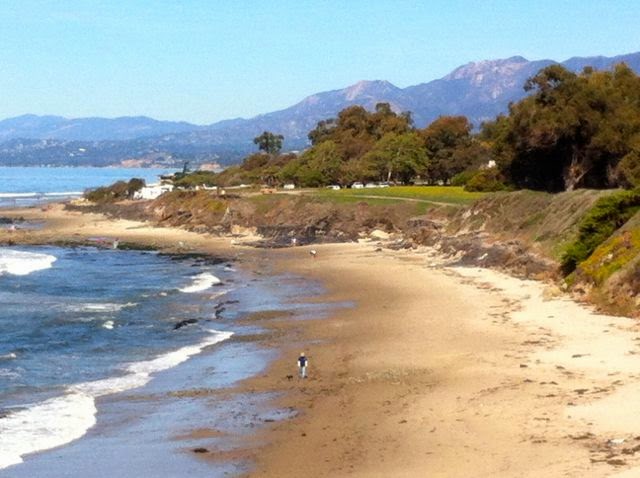
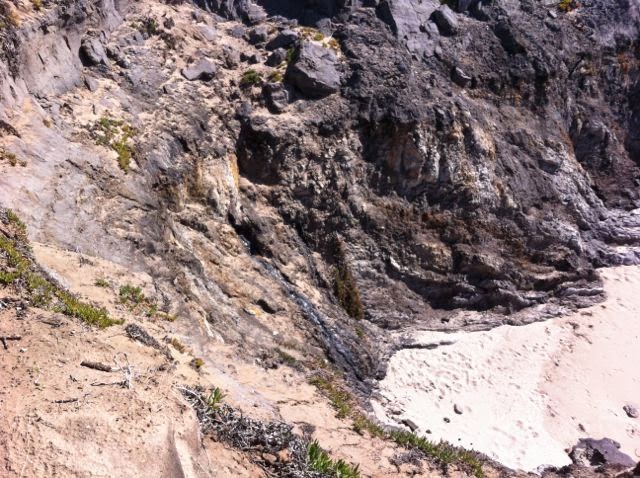
This year we continued our walk along the bluffs beyond the pier, heading west to Tar Pits Park.  There we could see one of the places along the beach where the asphaltum bubbles out forming a mound from the bluff onto the sand.   Looking west we could see a bit trickling out from the rocks down toward the beach, too.

Tar pits park - looking west
Tar "sliding" down the rocks
You may want to read more about Carpinteria's Tar Pits, which are pretty cool!  In our book (Lentz 2013) see pp 57-60.  There is also information about the site on these pages:
from carpinteria.com,   caopenspace.org,  and parks.ca.gov 

From the latter: 
“The Carpinteria Tar Pits once bubbled up near the state beach. Spanish explorers noted that the Chumash caulked their canoes and sealed their cookware with the asphaltum. Around 1915, crews mined the tar, which was used to pave the coast highway in Santa Barbara County. In order to dig the tar, workmen had to heat their shovels in a furnace; the smoking tar would slice like butter with the hot blade. Long ago, the tar pits trapped mastodons, saber-toothed tigers and other prehistoric animals.”


Wednesday, April 25, 2012

Starting up after a long hiatus...
Walking Biology 2012 has begun with two nice field trips so far:

Carpinteria Bluffs to see the harbor seals


And the SB Botanic Garden to observe flowers and their pollinators.


Feel free to post comments or your photos from the trips!

Thursday, April 17, 2008

Photos: Harbor Seal Rookery (Carpinteria Bluffs)

Here is a slideshow with photos from our second field trip to the Harbor Seal Rookery at the Carpinteria Bluffs.

Carpinteria Bluffs

Our field trip in week 2 was to the Carpinteria Bluffs – a 52 acre coastal property with great views of the Santa Ynez mountains, the ocean and the Channel Islands.
Local residents, with help from the Santa Barbara Land Trust, worked to purchase this property and maintain it as open and undeveloped space. The history of this preservation effort is described in this site for the SB Land Trust, and this one for the Citizens for the Carpinteria Bluffs. We are all fortunate to have access to this now-public site thanks to their determination, vision, and hard work!
Though much of the vegetation we saw was non-native, there is active restoration of native coastal scrub species at the site (we saw California sagebrush, coyote bush, California bush sunflower, purple needle grass, and others). The dominant grass we saw was the pretty, but invasive, veldt grass, introduced from S. Africa. We enjoyed the shade walking along the long row of tall eucalyptus trees. Here, and previously, we discussed the introduction of eucalyptus from Australia and Tasmania to California in the mid 1800’s.
One of the special aspects of this site is the harbor seal rookery east of the Casitas pier and visible from the bluffs. Though it’s not uncommon to see a lone harbor seal in the nearshore waters or even groups of them hauled out on local secluded beaches, this is one of only a few sites along the southern California coast where the seals come to give birth to their pups.
The beach is closed 750 feet on either side of the rookery from December through May, so that disturbance is minimizing during the season when pups are born and weaned. From the excellent viewing location on the bluff above the rookery we were able to see a few small harbor seal pups in addition to the many adult and juvenile seals lounging on the beach and rocks. When you come back on your own, if you want to see the pups when they’re first born, come a little earlier in the year, like February or March. As was the case when we were there, generally a member of Seal Watch is there, and he or she will be happy to answer questions or fill you in on the latest activities happening at the site.
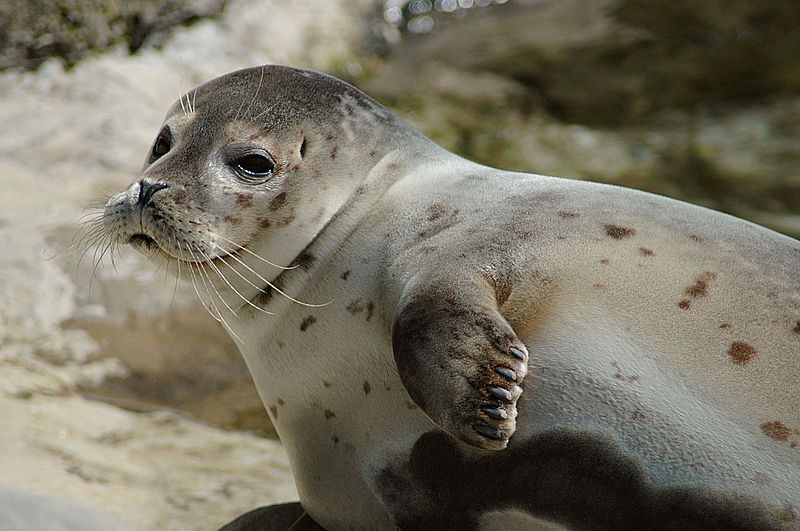
Here are a few links to sites with information about harbor seals, Phoca vitulina. (The lovely photo is from wikipedia – photo credit Marcel Burkhard)
from Venoco (the oil co. next door...)

By the way, do you know the poem Rudyard Kipling wrote about seals? Perhaps next time you come to this site, you’ll want to bring it with you…
Seal Lullaby
By Rudyard Kipling
Oh! hush thee, my baby, the night is behind us
And black are the waters that sparkled so green.
The moon, O'er the combers, looks downward to find us
At rest in the hollows that rustle between.
Where billow meets billow, there soft by the pillow.
Oh, weary wee flipperling, curl at thy ease!
The storm shall not wake thee, no shark shall overtake theeAsleep in the storm of slow-swinging seas.

map to our field trip site