Showing posts with label Rocky Intertidal. Show all posts

Monday, April 27, 2015

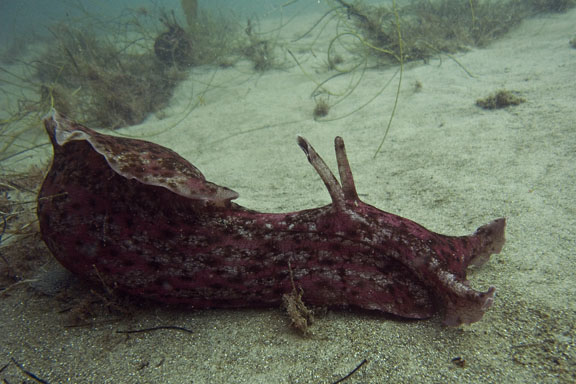
Sea hares!

Wow! We saw SO many sea hares on our trip to the Coal Oil Pt tidepools on April 16th.  The California sea hare (Aplysia californica) is a gastropod mollusk (think common garden snail) without an external shell.  This species is found along the California coast.


Some interesting notes about its physical characteristics:

Alpysia has two pairs of tentacles on top of its head: one pair up front near the mouth that help in movement and another behind the eyes used in olfaction. It is the large anterior tentacles, which resemble the ears of a hare, that are responsible for the common name - sea hare.

The color of sea hares, which can range from purple-reddish-brown to greenish-brown, depends on the color of algae they eat.  This year we saw many sea hares that were definitely more on the green end of that scale, which makes me wonder if there is different availability of algae from previous years.

These guys can get big - CA "brown" sea hares (Aplysia californica) can get to be up to 40 cm (16 in) long.  However its close relative - the California black sea hare (Aplysia vaccaria) gets even bigger, up to 75 cm (29 in), making IT the largest gastropod in the world.

And about its reproduction....
we mentioned in the field that sea hares are hermaphrodites - simultaneously both male and female.  For a peak at their mating "strategies" check out this National Geographic video entitled "World's Weirdest - Underwater Love Chain" !!


 and links to previous entries about rocky intertidal trips are here.

Wednesday, April 30, 2014

What a day at Coal Oil Point! Whales and octopus and plovers, oh my!

from marinebio.net by Genny Anderson
Sparklin' day at Coal Oil Point last Thursday - starting with the two gray whales breaching just beyond the kelp forests off the point!   At this point the gray whales are migrating north, back to the Bering Sea where they spend the summer.  Check out SBCC prof Genny Anderson's site for information about the gray whales and their journey past our coast.


Thanks to Zeke for finding our first octopus!  Again, some great info about this and other "treasures" we spotted, like the sea hare, I recommend Genny's site.  This is the page to read about low intertidal organisms.

We saw some of the sandy beach denizens.... those beach hoppers under the drying kelp wrack are so crucial to maintaining the bird diversity we saw.  Here is a nice page by UCSB researcher, Jenny Dugan, about the role of beach wrack and comparisons of "groomed" vs ungroomed beaches.

And finally, if you'd like to read about the snowy plover program (and perhaps even volunteer to be a docent)  click here!

from http://coaloilpoint.ucnrs.org/SnowyPloverProgram.html


Thursday, May 1, 2008

Photos: Rocky Intertidal (Arroyo Hondo)

Here is a slideshow with photos from our fourth field trip to the Rocky Intertidal at Arroyo Hondo.

Arroyo Hondo and our class


I really like the bridges at Arroyo Hondo. The concrete one was built in 1918 as part of the original highway (more details from some road enthusiasts). The culvert that goes underneath the bridges (a picture from when I visited a while ago) is steelhead trout habitat.


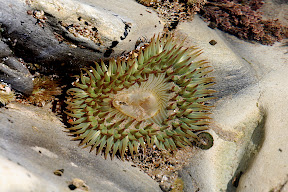
The beach had zillions of sea anemones, both underwater (waving around and greenish from algae) and hanging out on the rocks (closed up and camouflaged with sand). We weren't sure why some of them had white spots in their tentacles.